
OpenClaw (formerly known as Clawdbot and Moltbot) is a viral, open-source autonomous AI agent created by developer Peter Steinberger, which rapidly evolved into a foundational enterprise tool following a strategic acquisition by OpenAI.
Imagine granting a digital assistant full access to your sensitive files and internal messaging. Now, imagine watching that same software undergo three chaotic identity changes in a single week. This is the real story behind Steinberger’s viral AI creation. In this article, you will explore a chronological breakdown of how a simple weekend project exploded into a global phenomenon. We will track its rapid evolution through three distinct brands: Clawdbot, Moltbot, and OpenClaw. You will discover the specific legal battles and cybersecurity crises that forced each sudden pivot.
Enterprise adoption of autonomous AI is accelerating fast. However, giving an AI “air traffic control” over your business data introduces unprecedented security and supply-chain risks. The OpenClaw rebranding journey—from a trademark-infringing side project to an OpenAI-backed foundation—serves as a critical case study for modern tech leaders.
The key takeaway: As businesses shift from simple chatbots to autonomous agents, establishing a responsible generative AI strategy with strict security protocols and transparent oversight is no longer optional—it is a baseline requirement for survival.
1. The ‘Clawdbot’ Origins: What Caused the Trademark Reality Check?
Why Did Clawdbot Go Viral as a Local-First Assistant?
In November 2025, developer Peter Steinberger launched a simple weekend project called “Clawdbot.” It quickly exploded into a global sensation. According to project metrics, Clawdbot gathered over 100,000 GitHub stars and saw two million visitors in just one week.
The appeal was clear and immediate. Unlike a passive chatbox, it acted as a proactive “digital Chief of Staff.” You could ask it to execute real-world tasks right from your daily messaging app.
Most importantly, it ran entirely on your own computer. Enthusiasts started dusting off old machines, sparking a massive “Mac Mini revival.” This local-first AI setup kept sensitive business data safe and off public corporate cloud platforms, which is a massive priority for small businesses adopting AI tools.
What Was the Anthropic Trademark Dispute?
However, this viral success soon hit a sudden legal roadblock. On January 27, 2026, the AI company Anthropic reached out with a polite request. They asked Steinberger to change the name of his project.
The name and its lobster mascot “Clawd” sounded too much like Anthropic’s own flagship AI model, Claude. This Clawdbot trademark dispute forced the creator into a rapid, unexpected pivot to shed its old branding.
The business lesson: This legal clash highlights a major risk in today’s crowded AI market where product wrappers and underlying AI models frequently overlap. For business leaders, this proves that adopting open-source tools requires strict legal checks and transparent oversight from day one.
2. The ‘Moltbot’ Vulnerability Window: What Were the Enterprise AI Risks?
How Did a Rushed Rebrand Lead to Moltbot Security Vulnerabilities?
To satisfy trademark demands, the project quickly changed its name to “Moltbot.” This rushed pivot created a dangerous 10-second window of pure chaos. Grifters and bots instantly grabbed the old X (formerly Twitter) handle and GitHub account to pump fake crypto schemes.
The confusion also opened the door for direct cyberattacks. Because the open-source community moves fast, bad actors took advantage of the Moltbot security vulnerabilities. According to reports on the malicious plugins, attackers uploaded 14 malicious “skills” to the public ClawHub registry.
These plugins masqueraded as helpful crypto automation tools. In reality, they attempted to deliver malware directly to macOS and Windows systems. This proves that unvetted community plugins can easily harm your business network, much like the dangers discussed in our guide to third-party app security risks.
What Was the Infostealer Threat and the “Security Nightmare”?
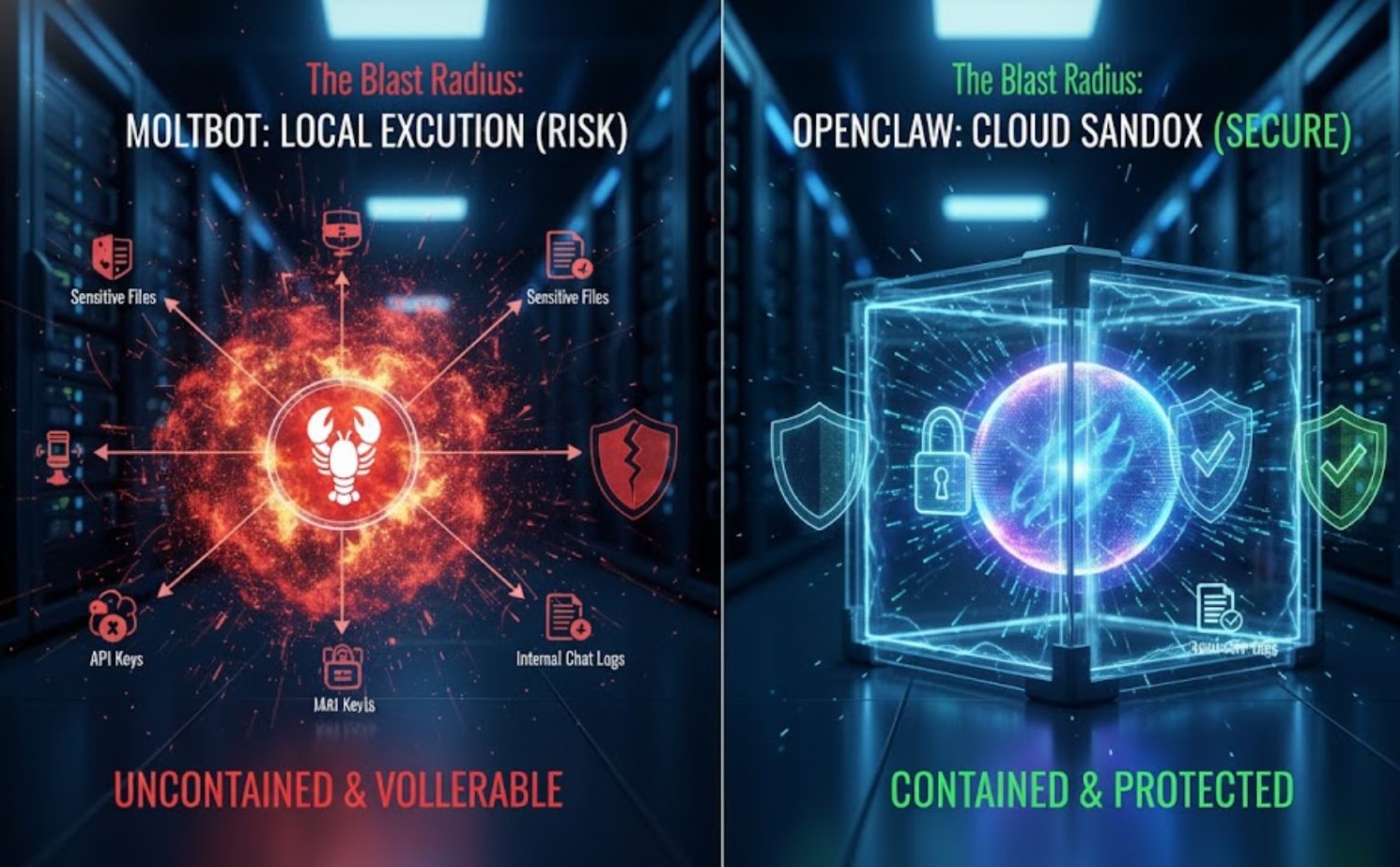
Industry experts quickly labeled this viral success a total “security nightmare.” Researchers at SOCprime discovered a massive vulnerability gap: over 1,000 unsecured public Moltbot instances were exposed online. These unprotected control panels were leaking:
- Sensitive API keys
- Private chat histories
- Critical system credentials
Furthermore, cybersecurity firm Hudson Rock discovered a first-of-its-kind infostealer malware targeting the AI agents. This malware specifically targeted the AI’s configuration files to extract authentication tokens. This massive attack surface exists because the agent requires root-level or “sudo”-level access to function properly on a local machine.
If an attacker uses prompt injection, they can force the AI to execute silent data exfiltration—stealing your data without you ever knowing.
The key takeaway: For business leaders, the Moltbot phase highlights the extreme enterprise AI risks of giving any software unsupervised control. Securing these agents requires robust endpoint security and a thorough understanding of the specific OpenClaw security risks.
3. Securing the ‘OpenClaw’ Era: What Are the Lessons in Open-Source AI Deployment?
How Did the OpenClaw Reset Stabilize the AI Agent Lifecycle?
On January 30, the project finally settled on the name “OpenClaw.” Creator Peter Steinberger chose this name to emphasize the assistant’s open-source nature. This time, according to the official rebranding announcement, the team thoroughly prepared by clearing trademark searches and securing all necessary website domains.
To address the massive vulnerabilities, Steinberger quickly deployed 34 security-hardening commits to protect the OpenClaw codebase. Despite these rapid improvements, he warned the community that prompt injection remains an industry-wide unsolved problem.
This serves as a stark reminder that perfect security does not yet exist for agentic AI. Just like tracing a physical supply chain, digital tools require constant audits and third-party validation throughout the AI agent lifecycle.
What Enterprise Guardrails Are Needed for Autonomous Agents?
Business leaders must treat this chaotic timeline as a crucial learning opportunity. If your company is exploring an autonomous AI strategy, you cannot afford to deploy these tools without enterprise-grade guardrails.
First, your IT teams must enforce strict authentication protocols. You should establish network allowlists and use segmented API keys to prevent accidental exposure. You must demand the same level of ethical sourcing and validation from your software as you do from your physical vendors.
Second, developers must utilize safer, sandboxed execution environments. Running these agents inside tight software containers limits the blast radius. If an AI ever goes rogue, strict boundaries protect your core business data, highlighting exactly why robust endpoint security is non-negotiable.
In summary: Deploying agentic AI like OpenClaw requires sandboxed execution environments, network allowlists, and strict API segmentation to effectively mitigate enterprise AI risks.
4. The Mainstream Leap: How Will the OpenAI Open-Source Acquisition Shape the Enterprise Future?
What Does Moving to an Open-Source Foundation Mean for Business?
The project’s chaotic but successful journey reached a major milestone on February 15, 2026. OpenAI CEO Sam Altman announced that OpenClaw creator Peter Steinberger joined the company to lead the development of next-generation personal agents.
This strategic move signals a massive industry shift. We are moving from passive chat tools to proactive, autonomous AI. However, the software itself will not disappear behind a corporate paywall.
Instead, according to Reuters, OpenClaw will transition into an independent foundation. This ensures the project remains open-source and community-driven, while receiving powerful technical backing from OpenAI.
The bottom line: For enterprise leaders, this OpenAI open-source acquisition strategy is a clear signal to prepare your infrastructure now. Establishing secure frameworks today is the only way to safely harness the benefits of AI efficiency, safety, and reliability as autonomous agents become the new enterprise standard.

Conclusion: How Can Your Enterprise Safely Navigate the AI Agent Lifecycle?
The rapid journey from Clawdbot to OpenClaw serves as a perfect microcosm of today’s AI industry. The technology is moving incredibly fast, breaking established rules, and scrambling to secure vulnerabilities.
Scaling autonomous AI requires much more than just powerful code. It demands rigorous trademark foresight, zero-trust security postures, and proactive governance. The legal and cyber threats exposed during the OpenClaw rebranding journey prove that innovation without strict oversight is incredibly dangerous.
Business leaders must take immediate action. To safely deploy open-source agents, you must:
- Establish clear internal policies to monitor shadow AI and open-source agent deployment.
- Enforce zero-trust security to ensure that no AI tool is ever granted unsupervised administrative privileges over your sensitive corporate data.
- Maintain proactive governance by continually auditing your digital supply chain, as recommended in our 10 pillars of a responsible generative AI strategy.
By building these secure guardrails today, your enterprise can safely harness the power of tomorrow’s autonomous agents. If your team needs expert guidance in navigating these enterprise AI risks, explore our technology support packages or contact the Azence team today.