
Someone just asked ChatGPT for “the best plumber near me.” It named three businesses. Yours wasn’t one of them, and that customer never even opened Google.
This is the new front door. AI Overviews, ChatGPT, and Perplexity now answer questions before anyone clicks a link. If those tools can’t understand your business, you’re invisible at the exact moment a buyer is deciding.
So you’ve heard the fix is schema markup. You’ve also heard it’s a magic bullet that guarantees “3x more citations.” One of those claims is worth your time. The other is hype.
Here’s what you’ll actually learn: what schema markup for AI search really does, which schema types matter for a small or local service business, and how to set it up without losing a weekend to code that changes nothing.
The honest truth up front: schema is essential infrastructure, not a magic bullet. The real win comes from connecting your business facts into one graph AI can trust, paired with content that’s genuinely worth citing. Let’s start with what schema actually does.
What Schema Markup for AI Search Actually Does
Let’s clear up the confusion before you touch a single line of code.
Schema markup, explained in plain English
Schema markup is code that labels the facts on your page. It tells AI who you are, what you do, and where you serve. Now the machine reads meaning, not just words.
Think of your webpage as a paragraph an AI has to skim. Schema is the highlighter that marks “this is the business name,” “this is the phone number,” “this is the service area.” Without it, your page is a blur of text. With it, the facts are labeled and ready to use.
For AI search specifically, structured data does three jobs:
- Disambiguates your entities, so the AI knows your business from a dozen others with a similar name.
- Extracts exact facts, pulling clean details like hours, location, and services instead of guessing.
- Makes your content citeable, giving the engine confident, ready-made facts to quote in a generated answer.
Why JSON-LD is the format that matters
Use JSON-LD. That’s the whole debate. It’s Google’s recommended format and holds roughly 89% of the structured-data market, so you’re not betting on a fringe standard.
JSON-LD sits in one tidy block in your page’s <head>, completely separate from your layout. That means you can update it without touching your design.
One caution: render it server-side. Some AI crawlers don’t run JavaScript, so a block that loads late may never be seen.
The Honest Truth: What Schema Does and Doesn’t Do
Here’s where most guides oversell. We won’t. Let’s separate what’s confirmed from what’s marketing noise.
Which platforms have actually confirmed they use schema
Two major platforms have said, on the record, that schema helps their AI understand your content.
- Google AI Overviews. In April 2025, Google’s Search team confirmed that structured data gives your content an advantage in search.
- Microsoft Bing Copilot. In March 2025, Microsoft’s Fabrice Canel confirmed that schema markup helps the company’s LLMs understand your pages.
For those two, schema isn’t a theory. It’s confirmed infrastructure.
And ChatGPT and Perplexity? They haven’t confirmed it. Neither has publicly said whether it keeps or uses your schema when crawling the web. The capability may exist, but no promise has been made. Don’t let anyone tell you otherwise.
What the research really shows
Now the part the hype crowd skips.
A December 2024 study from Search/Atlas found no correlation between schema coverage and AI citation rates. Sites loaded with schema didn’t reliably beat sites with little or none. Translation: schema alone doesn’t buy you citations. AI systems appear to reward relevance, topical authority, and clear writing first.
But schema still earns its keep. AI models tend to pull facts more accurately when those facts sit in clearly defined fields instead of loose prose. Think of it this way: an AI does better filling out a form than staring at a blank page. Schema is that form.
The Schema Types That Matter for a Small or Local Business
You don’t need all 800-plus schema types. For a small or local business, a handful do the heavy lifting.
Organization + LocalBusiness: your identity layer
Start here. This is non-negotiable.
Organization schema states your name, logo, and contact details, plus sameAs links to your real social and knowledge profiles. It tells AI, “this is a real brand, and here’s proof.”
LocalBusiness schema adds your exact address, opening hours, and areaServed. That’s the difference between “a business” and your business showing up in a “near me” answer.
Person: the E-E-A-T lever most competitors skip
Mark up the humans behind your business. Add each team member’s name, role, and credentials, then connect each one worksFor your Organization.
Why bother? Because AI weighs E-E-A-T (Experience, Expertise, Authoritativeness, and Trust) when picking a source. A named expert with real qualifications beats an anonymous website every time. Most competitor guides skip this. You shouldn’t.
Service, Not Just Product
Here’s the gap almost every guide misses. They obsess over Product schema, which is built for online stores selling physical goods.
You’re a service business, so you need Service schema, not just Product. Define your serviceType, the provider (that’s you), and your areaServed. This tells AI exactly what you do and who you do it for. That’s the detail e-commerce-focused advice leaves out.
Article and FAQPage: your content pages
For blog posts and guides, Article (or BlogPosting) schema marks the author and freshness dates (datePublished and dateModified). AI favors clearly attributed, recently updated content.
A quick honest note on FAQPage schema: its status is in flux. There are credible reports that Google is winding down FAQ rich results, so we’re not recommending you invest in FAQ markup right now. Writing a genuine FAQ section on your page is still smart, just hold off on the schema until the dust settles.
Notice something? Person worksFor Organization. Service names its provider. These types want to connect. That’s the whole game, and it’s where we head next.
Why a Connected Entity Graph Beats Isolated Tags
This is the part almost nobody gets right, and it’s where your schema starts actually earning its keep.
Isolated blocks vs. one connected graph
Structured data for AI search engines isn’t about how many tags you add. It’s about how well they connect. Most sites bolt on separate schema blocks that never talk to each other. An Organization block here, an Article block there, a Service block somewhere else, all strangers on the same site.
That works fine for old-school rich snippets. But AI wants to know how your facts connect. Who wrote this? Which brand stands behind it? What service does that brand offer, and where?
The fix is a connected entity graph: one structure where every fact links to the others. Think of isolated tags as loose index cards. A graph wires them into a chart the AI can actually follow.
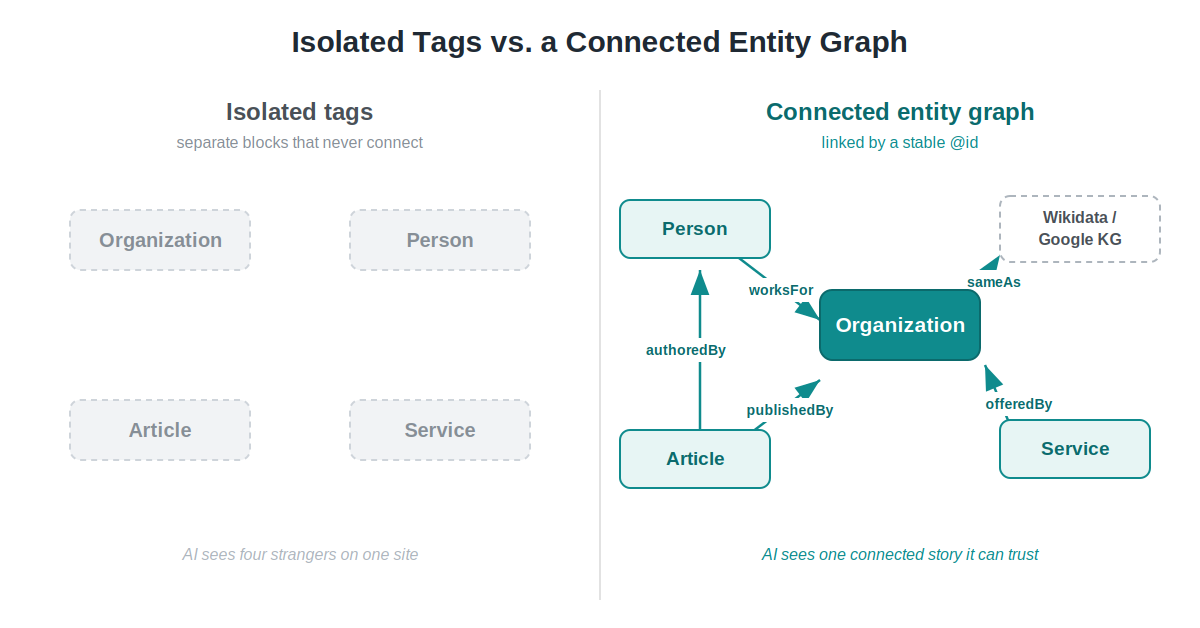
Here’s the difference at a glance:
| Aspect | Isolated tags | Connected entity graph |
|---|---|---|
| Structure | One @type block per page | A @graph array of linked nodes |
| Entity ID | None; every block is anonymous | Stable @id reused across your site |
| Relationships | One-way, nested by name | Two-way links via @id (worksFor, authoredBy) |
| Main benefit | Rich snippets and click-through | Entity clarity and cleaner AI extraction |
| AI impact | Minimal; often ignored | Behaves like your own mini knowledge graph |
How to connect your entities
The trick is a stable @id for each core entity, then linking them together. Give your Organization, Person, and Service each a permanent @id URL. Then wire them:
- Your Person
worksForyour Organization. - Your Article is
authoredBythat Person andpublishedBythat Organization. - Your Service is
offeredByyour Organization.
Now the AI sees one connected story, not scattered scraps.
One more move: use sameAs to point your entities at trusted outside references, like your Wikidata entry, Google Knowledge Graph profile, or verified social pages. This is how you tell AI “this is definitely us, not a competitor with a similar name.”
For a deeper look at how entities connect to real results, this industry discussion is a useful watch:
How to Implement and Validate Without Breaking Anything
Good news: you don’t need to be a developer to get this right. You just need to be careful.
Getting schema onto your site
If you’re on WordPress, a plugin does most of the work. Tools like Rank Math or Yoast generate a solid starting block of structured data for you, with no hand-coding required.
On another platform or a custom site? Use a free JSON-LD generator, fill in your business details, and paste the result into your page’s <head>. Most site builders have an “insert code” or “custom HTML” spot for exactly this.
Match your schema to what’s actually on the page
Here’s the mistake that backfires: marking up things that aren’t really there. Claiming reviews, prices, or services in your code that a visitor can’t see on the page is called schema drift, and it erodes the trust that makes AI cite you in the first place.
The rule is simple. Only mark up what’s genuinely on the page, and keep it current. If your prices or hours change, update your schema too. False signals don’t just fail to help. They actively hurt.
Validate it, then keep an eye on it
Never assume it works. Check it. Three free tools cover you:
- Google Rich Results Test confirms your page qualifies for rich results.
- Schema.org Validator catches syntax and type errors.
- Google Search Console (Enhancements tab) monitors your schema across the whole site.
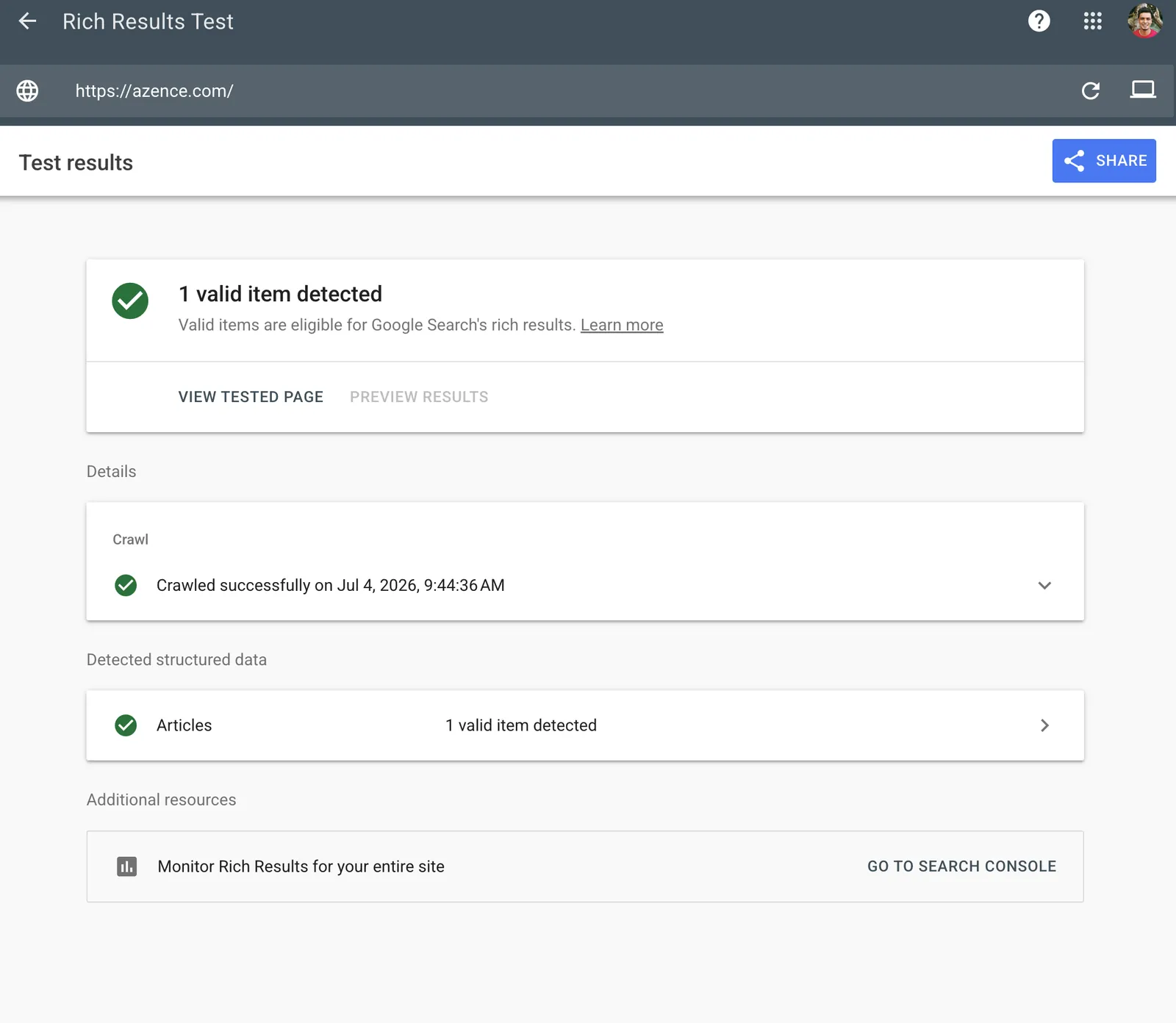
Then re-audit after any big site change. A theme update or redesign can quietly break your markup, and broken schema is worse than none.
The Bottom Line: Schema Is Infrastructure, Not a Magic Bullet
Let’s tie it together. Schema markup for AI search is real, it’s confirmed by Google and Bing, and it’s worth your time. But it’s plumbing, not a growth hack.
Here’s the part the hype crowd won’t tell you. Piling on tags won’t buy you citations, and nobody can promise you “3x more mentions.” The real win is quieter: connect your business facts into one trustworthy JSON-LD graph, then pair it with content that’s genuinely worth citing. Structure plus substance. That’s the whole formula.
So don’t boil the ocean. Your first three moves are simple:
- Start with Organization and LocalBusiness schema, your identity layer.
- Connect your entities with stable
@idlinks so they reference each other. - Validate with the free tools, then keep it accurate.
Do that, and you’ve built real infrastructure AI can trust.
Want a shortcut? AZENCE can audit your current setup and build the connected graph for you, with no lock-in and results you can see in 30 to 90 days.
Frequently Asked Questions
Does AI use schema markup?
Yes, for some platforms it’s confirmed. Google (April 2025) and Microsoft’s Bing (March 2025) have both said structured data helps their AI understand your content. ChatGPT and Perplexity haven’t confirmed whether they use it, so treat any promise there with healthy skepticism.
Is schema markup still relevant in the AI era?
More relevant, not less. The job has simply changed. Schema used to be about winning rich snippets in search results. Now it’s about helping AI comprehend your business as a clear, connected entity, which is exactly what generative engines need to cite you.
What is an example of schema markup?
Here’s a simple LocalBusiness block you could place in your page’s <head>:
{
  "@context": "https://schema.org",
  "@type": "LocalBusiness",
  "name": "Your Business Name",
  "url": "https://yourwebsite.com",
  "telephone": "+1-555-123-4567",
  "address": {
    "@type": "PostalAddress",
    "streetAddress": "123 Main St",
    "addressLocality": "Your City"
  },
  "areaServed": "Your City and surrounding areas"
}
How do I structure content for AI search?
Lead every section with a direct, one-sentence answer. Use clear, question-based headings that match how people actually ask. Then back your schema with real, visible content, so the words on the page and the code behind it always agree.